
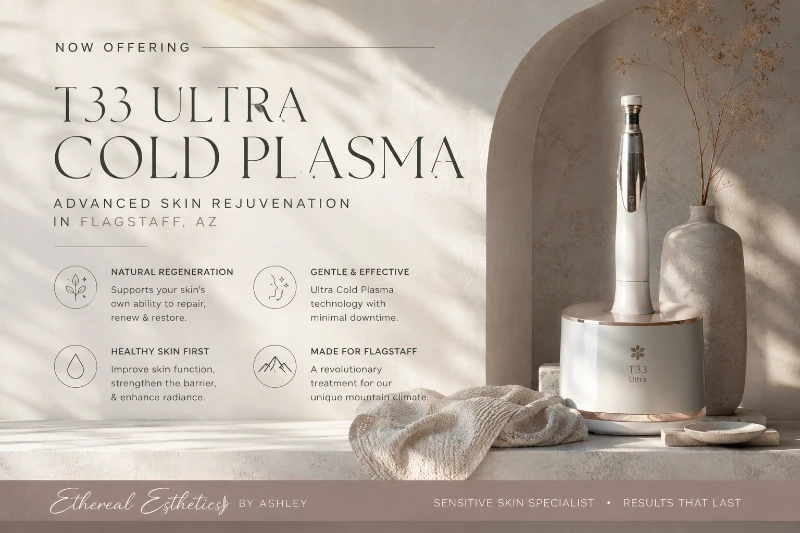
If you’ve been searching for a more natural, science-backed approach to skin rejuvenation in Flagstaff, Arizona especially if you have sensitive, reactive, or easily irritated skin, you may have wondered whether your, only options are injectables, aggressive resurfacing treatments, or simply accepting the changes you’re seeing in your skin.
I don’t believe those are your only choices.
At Ethereal Esthetics by Ashley, my philosophy has always been that beautiful skin starts with healthy, well-functioning skin. I don’t want to simply chase wrinkles or temporarily mask what we see on the surface. I want to support the skin so it can become stronger, more balanced, more resilient, and better able to renew itself over time.
That philosophy is exactly why I decided to introduce Ultra Cold Plasma to my Flagstaff treatment room.
For many of my clients, especially those with sensitive skin, it’s an exciting way to explore advanced skin rejuvenation without immediately turning to aggressive heat-based resurfacing or injectable treatments.
A Different Way to Think About Skin Rejuvenation
Many of the most familiar aesthetic treatments work by intentionally creating controlled stress or injury in the skin.
That isn’t necessarily a bad thing. Controlled wound-healing responses are an important part of many effective professional treatments, including certain lasers, chemical peels, and microchanneling procedures.
But they aren’t always appropriate for every person or every skin barrier.
This becomes especially important when I’m working with skin that is already reactive, dehydrated, inflamed, or environmentally stressed.
Rather than assuming that stronger is always better, I prefer to ask:
What does this person’s skin actually need right now?
Sometimes the answer is stimulation.
Sometimes it’s hydration.
Sometimes it’s barrier repair.
And sometimes we can encourage rejuvenation without creating the degree of heat, peeling, or visible trauma associated with more aggressive procedures.
That’s what makes cold plasma technology so interesting to me.
What Is Cold Plasma?
Most of us learned about three basic states of matter in school:
- Solid
- Liquid
- Gas
There is also a fourth state: plasma.
Plasma is created when energy is introduced into a gas and produces a mixture containing charged particles and reactive molecules.
Plasma exists naturally all around us. Lightning is one example, and the sun is largely made of plasma.
In recent years, researchers have developed Cold Atmospheric Plasma, often abbreviated CAP, which can be generated at temperatures low enough for applications involving the skin.
Rather than relying primarily on intense heat, cold atmospheric plasma creates a combination of reactive oxygen and nitrogen species and other physical components that interact with biological tissue.
Researchers are currently studying these interactions for their potential roles in skin healing, antimicrobial activity, inflammation signaling, tissue regeneration, and other dermatologic applications.
Why Is T33 Called “Ultra Cold” Plasma?
The word plasma can sound intimidating because people often associate it with heat.
T33 Ultra Cold Plasma is designed differently from older thermal plasma technologies.
The treatment uses cold plasma technology rather than the significant heat associated with many resurfacing procedures.
For my clients, that means the treatment experience can be surprisingly comfortable, with much less disruption to daily life than they may expect from an advanced rejuvenating treatment.
Depending on your individual skin and treatment protocol, benefits can include:
- Minimal downtime
- Little to no peeling
- Limited visible redness
- A comfortable treatment experience
- A relatively quick return to normal activities
That can be especially valuable here in Flagstaff, where many of us have busy schedules and active lifestyles and don’t necessarily want to disappear for a week after a skincare appointment.
The Science Behind Cold Atmospheric Plasma
One of the reasons I became so interested in cold plasma is the science surrounding reactive oxygen species and reactive nitrogen species, often called ROS and RNS.
You’ve probably heard reactive oxygen species described as “free radicals,” which can make them sound universally harmful.
But biology is more complicated than that.
Our bodies naturally use controlled amounts of reactive molecules as part of normal cellular signaling. In appropriate concentrations, these molecules participate in processes associated with cellular communication, tissue repair, immune responses, and wound healing.
Cold atmospheric plasma temporarily creates reactive oxygen and nitrogen species at the skin’s surface, and researchers are studying how those signals interact with skin cells and surrounding tissue.
Research into cold atmospheric plasma is still evolving, but areas being investigated include:
- Skin and tissue regeneration
- Wound healing
- Antimicrobial effects
- Inflammatory signaling
- Cellular communication
- Collagen-related remodeling
- Skin barrier function
I think it’s important to be clear here: cold plasma is an emerging area of regenerative aesthetics, not magic.
That’s actually part of what makes it exciting to me.
Rather than promising an overnight transformation, it gives us another tool for supporting healthier-looking skin through biological processes that researchers are continuing to understand.
Why Ultra Cold Plasma Fits the Ethereal Esthetics Philosophy
If you’ve been my client for any length of time, you’ve probably heard me say that I don’t believe healthy skin starts with chasing wrinkles.
It starts with function.
When your skin is functioning well, it is generally better able to retain moisture, maintain its barrier, recover from environmental stress, and tolerate the treatments we use to improve its appearance.
Healthy skin tends to look better because it is healthier.
My goal is to help your skin become:
- Stronger
- Better hydrated
- More resilient
- More balanced
- More radiant
- Better able to recover from everyday stress
And no device can replace the foundations of healthy skin.
Quality sleep matters.
Nutrition matters.
Stress matters.
Hormonal changes matter.
Movement matters.
Home skincare matters.
Reducing unnecessary inflammation matters.
Professional treatments should support those pieces—not pretend they don’t exist.
T33 fits into my practice because it gives me another way to support the skin without automatically reaching for the most aggressive option available.
An Especially Interesting Option for Sensitive Skin
This is where T33 becomes particularly exciting for my practice.
I specialize in working with sensitive, reactive, redness-prone, and compromised skin.
Those clients are often the ones who feel left out of advanced aesthetics.
They want help with aging, texture, pores, dullness, laxity, acne, or uneven tone—but they’re understandably nervous about treatments that could create significant redness, peeling, inflammation, or prolonged downtime.
And many arrive at my studio with a skin barrier that is already under stress.
That doesn’t mean sensitive skin can’t benefit from advanced treatments.
It means we have to be thoughtful about how and when we use them.
T33 gives me another option for creating a customized rejuvenation plan for clients who may not be ideal candidates for—or simply don’t want—more aggressive resurfacing.
A consultation is still essential, because sensitive skin isn’t one single skin type. Rosacea, impaired barriers, allergies, acne, dehydration, and true inflammatory skin conditions all need to be approached differently.
But “sensitive” should never automatically mean “there’s nothing we can do.”
Why Sensitive Skin in Flagstaff Needs Extra Consideration
Living at nearly 7,000 feet makes skincare in Flagstaff different.
We deal with a combination of:
- Low humidity
- Dry mountain air
- Strong sun exposure
- Wind
- Big temperature swings
- Cold winters and indoor heating
- Outdoor lifestyles that put our skin in the elements
All of these factors can place additional stress on the skin barrier.
And altitude matters when it comes to UV exposure, too. The higher the elevation, the greater the intensity of UV radiation reaching the surface.
That means many people in Northern Arizona aren’t beginning their skincare journey with perfectly calm, well-hydrated skin.
They’re already dealing with dehydration, redness, sensitivity, or a weakened barrier before we ever add a professional treatment.
This is why I don’t believe in treating Flagstaff skin exactly the same way you might treat skin living in a humid, sea-level climate.
Our environment matters.
And for my sensitive-skin clients, protecting the barrier while still helping the skin progress is one of my biggest priorities.
Is Ultra Cold Plasma an Alternative to Botox?
Botox and Ultra Cold Plasma work in completely different ways.
Botox temporarily reduces muscle movement in targeted areas, which can soften the appearance of expression lines.
Ultra cold plasma doesn’t freeze facial muscles.
Instead, it is used as a skin-focused treatment intended to support improvements in the appearance of firmness, texture, tone, and overall skin quality.
For someone who wants to maintain their natural facial movement and is more interested in improving the health and appearance of the skin itself, T33 may be an appealing option.
I personally love treatments that allow you to continue looking like you.
Your face should move.
You should be able to smile.
You should be able to express yourself.
My goal isn’t to make you look frozen or artificial. It’s to help your skin look healthier, fresher, firmer, and more vibrant while allowing your natural features to remain yours.
What About Laser Resurfacing?
Lasers can be incredibly effective treatments, and there are circumstances where they may absolutely be appropriate.
But not every client wants or needs that level of treatment.
Many resurfacing lasers intentionally use thermal energy to create controlled tissue injury, which triggers a wound-healing response and subsequent remodeling.
Depending on the type of laser and treatment intensity, this can also mean more redness, peeling, swelling, sun restrictions, and downtime.
T33 takes a different approach.
Because cold plasma does not rely on the same degree of thermal injury, it may be appealing for people looking for progressive skin rejuvenation with less interruption to their routine.
This is not about saying one technology is universally “better” than another.
It’s about having more options.
The best treatment is the one that fits your skin, your goals, your lifestyle, and your tolerance for downtime.
What Can T33 Ultra Cold Plasma Help Address?
Depending on your individual skin and treatment plan, T33 may be used to help improve the appearance of concerns such as:
- Fine lines and wrinkles
- Loss of firmness
- Uneven or rough texture
- Enlarged-looking pores
- Dullness
- Acne-prone skin
- Post-acne marks
- Certain scars
- Redness-prone skin
- Uneven tone
- General signs of environmental stress and aging
It may also be incorporated into a broader plan focused on strengthening and supporting compromised or sensitized skin.
Not every concern should be treated the same way, which is why every T33 treatment begins with an individualized assessment.
Does Ultra Cold Plasma Replace My Other Treatments?
Absolutely not.
One of the things I like most about ultra cold plasma is that it doesn’t have to stand alone.
Depending on your skin, goals, sensitivity level, and treatment history, your plan may also incorporate:
- Microchanneling
- Regenerative serums or growth-factor-based therapies
- PDRN
- Chemical peels
- LED light therapy
- Barrier-supportive facials
- Professional home skincare
I’ve never believed in one “miracle treatment.”
Skin is too complex for that.
The most effective plans usually come from combining the right treatments at the right time while continually adjusting to what your skin is telling us.
What Should You Expect During a Treatment?
Your appointment begins with a consultation and skin assessment so I can understand what your skin is doing that day, not simply what it was doing six months ago.
After thoroughly cleansing the skin, I use the handpiece across the treatment area according to a protocol selected for your skin and goals.
Depending on your treatment plan, I may also incorporate complementary professional products or regenerative therapies.
Appointments are generally comfortable, and treatment time varies depending on the areas we’re addressing and what we’re combining with your session.
Most clients are able to resume their normal routine shortly afterward, although I will always give you individualized aftercare instructions based on your treatment.
Why I Chose Ultra Cold Plasma
Every so often, I come across a technology that changes the way I think about what is possible in skincare.
T33 was one of those technologies for me. Not because it’s trendy. Not simply because it’s new. But because the concept aligns closely with the direction I’ve already been moving in my practice: supporting healthy skin function instead of constantly trying to overpower the skin.
The more I study sensitive skin, inflammation, longevity, collagen biology, barrier health, and regenerative aesthetics, the more convinced I become that beautiful long-term results come from creating healthier skin—not repeatedly exhausting it.
That doesn’t mean aggressive treatments never have a place.
It means they shouldn’t automatically be the first answer.
Especially for sensitive skin.
Experience Ultra Cold Plasma in Flagstaff, Arizona
If you’re looking for advanced skin rejuvenation but want an approach that prioritizes your skin barrier, natural expression, and long-term skin health, Ultra Cold Plasma may be worth exploring.
At Ethereal Esthetics by Ashley in Flagstaff, Arizona, I specialize in customized skincare for sensitive and reactive skin, and every treatment plan is built around the person sitting in front of me.
Whether your concern is fine lines, texture, redness, dehydration, loss of firmness, or simply wanting your skin to look healthier and more radiant, we’ll start by determining what your skin actually needs.
Because the goal isn’t to fight your skin.
It’s to help it function at its best.
Schedule a consultation to find out whether Ultra Cold Plasma is right for your skin.
One Response